CITES Conference of the Parties (CoP)20 Update: New Requirements for Pernambuco Trade Now in Effect
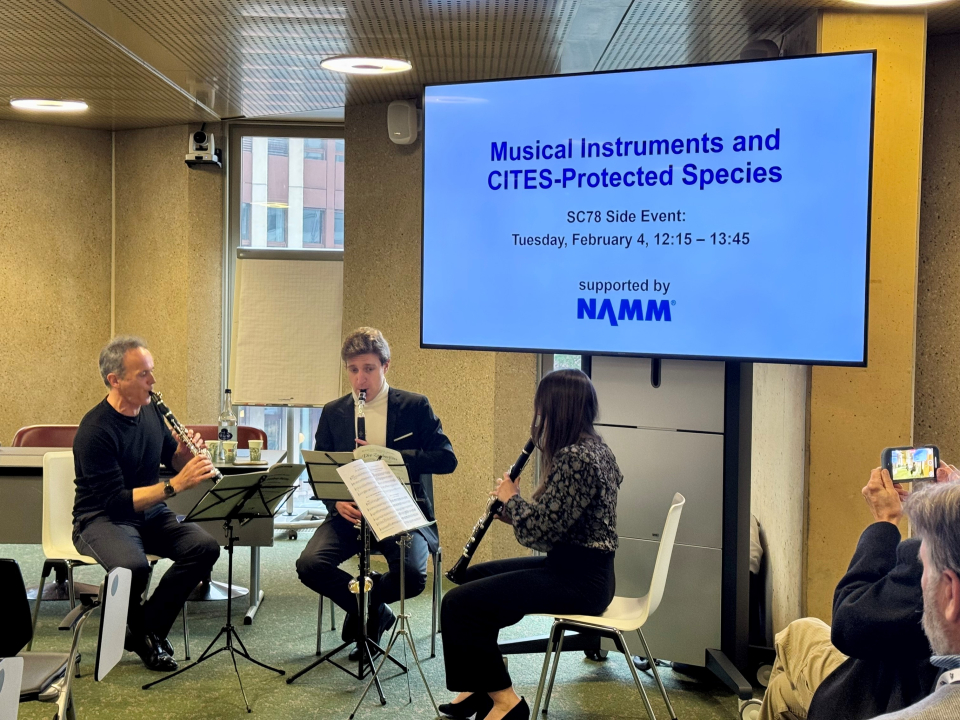
Significant changes to international trade requirements for pernambuco (Paubrasilia echinata) were adopted at the 20th meeting of the Conference of the Parties to the Convention on International Trade in Endangered Species of Wild Fauna and Flora (CITES CoP20), held in November and December 2025. NAMM actively participated in negotiations at CoP20 and sponsored a side event for delegates, ensuring the music products industry's perspective was represented throughout the process.
What Changed
Pernambuco has been listed under CITES Appendix II since September 13, 2007. At CoP20, Parties amended Annotation #10, which governs the species' trade conditions. The revised annotation took effect on March 5, 2026.
Under the amended annotation, finished musical instruments, musical instrument accessories (such as bows) and musical instrument parts may be transported internationally without CITES permits for non-commercial purposes — including paid and unpaid performance, personal use, display, loan, competition, teaching, appraisal and repair — provided that ownership does not change and the specimen is not for sale, transfer or disposal outside the owner's usual country of residence.
Commercial trade in all parts and derivatives, including finished bows, is subject to a zero quota for wild-harvested specimens. A key exception applies: specimens manufactured from pernambuco harvested before September 13, 2007, may be traded internationally for commercial purposes using a CITES pre-convention certificate, provided all applicable requirements are met.
What This Means for U.S. Stakeholders
The U.S. Fish and Wildlife Service (FWS), as the lead U.S. implementing agency for CITES, issued a letter this February to importers, exporters and re-exporters of pernambuco outlining these requirements. Because pernambuco is native only to Brazil, the U.S. does not issue U.S. CITES export permits for the species. Any commercial re-export from the U.S. will require documentation demonstrating that the wood originated from trees harvested before September 13, 2007.
All shipments of CITES-listed pernambuco specimens imported, exported or re-exported through the U.S. must be cleared through a designated port under U.S. Department of Agriculture Animal and Plant Health Inspection Service (APHIS) authority. Specimens qualifying for the non-commercial exemption under the revised annotation are not subject to designated port requirements.
Intersessional Work Ahead
CoP20 Parties also adopted decisions to be implemented between now and CoP21, expected in late 2028. These decisions address marking and traceability standards, stockpile management, conversion factors from raw wood to finished bows, outreach and awareness-raising, and the development of pernambuco plantations.
NAMM will continue to engage with FWS, CITES authorities and industry partners during this intersessional period. Members with questions about compliance should review the FWS stakeholder letter, available at fws.gov, or contact FWS at managementauthority@fws.gov or 703-358-2095.